
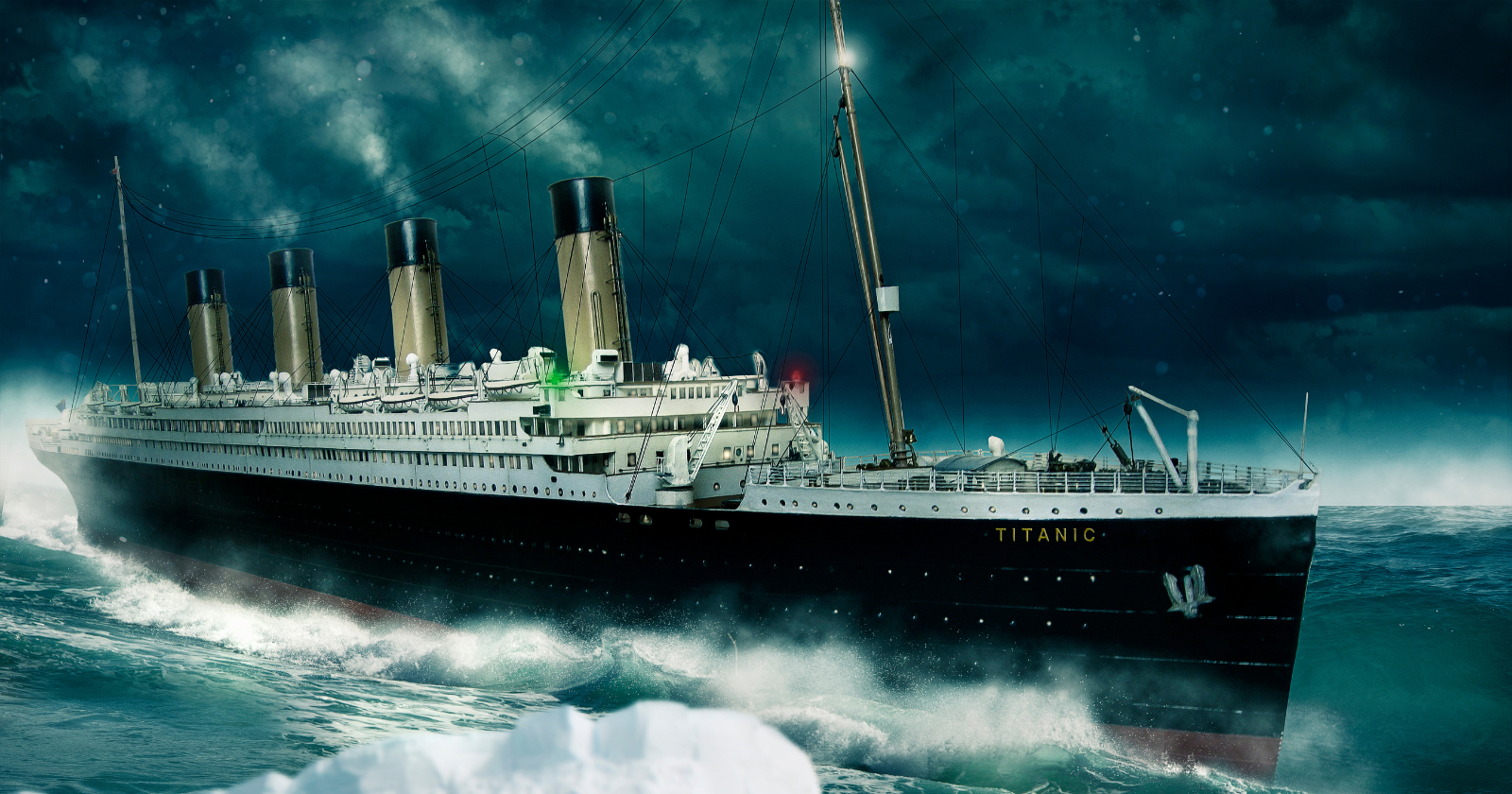
Milton Hershey held a stateroom on the Titanic for its maiden voyage in April 1912, paid a $300 deposit by check, and then walked away from the trip days before sailing because business in Hershey, Pennsylvania demanded his attention. The check survived. It sits in the Hershey Community Archives, never cashed, a small rectangle of paper that quietly separates the man who built the world’s largest chocolate factory from one of the most famous deaths in modern history.
The story gets retold every April for obvious reasons. But the more interesting layer — the part that matters to anyone who has ever signed a non-refundable deposit and then had to decide whether to actually show up — is what Hershey’s choice reveals about how founders weigh money already spent against opportunities not yet captured.
The $300 that bought a lesson in opportunity cost
Three hundred 1912 dollars is roughly $10,000 in present-day purchasing power. Not a rounding error. Hershey could afford it — he had already sold his caramel company for $1 million in 1900 and reinvested almost everything into chocolate manufacturing — but he was not a man who treated money carelessly. He grew up Mennonite. He had been bankrupt twice before he turned thirty.
So when business pulled him back, he made a choice that contradicts almost every behavioral pattern researchers have documented since. He let the deposit go. He boarded an earlier ship, the Amerika, and crossed the Atlantic ahead of the Titanic. The check stayed in a drawer.
Most people in his position would have rationalized the trip. The money was already spent. The stateroom was reserved. The social calendar was built around the crossing. Walking away meant admitting the $300 was simply gone — and that admission is exactly what behavioral economists have spent fifty years studying.
Why the sunk cost fallacy usually wins
The pull to honor money already spent has a name. Berkeley’s Greater Good Science Center calls it the sunk cost fallacy, and the pattern is well-documented: the larger the initial investment, the harder people find it to walk away. People who have given up more to pursue a path tend to stick with that path even when it is clearly failing.
The mechanism is simple. People want to be seen as consistent. Reversing course feels like an admission of error, and admission of error feels like loss. Hershey’s deposit was small relative to his fortune but large relative to the average person’s monthly wages at the time. The social pressure to use the ticket — the gossip value of crossing on the Titanic, the business contacts on board, the simple fact that everyone knew he had booked it — would have been considerable.
He ignored all of it. Forbes’ finance council has written about the same pattern in modern founders: the entrepreneurs who survive long enough to build something lasting are the ones who can treat money already spent as genuinely gone, rather than as a debt the future owes them.
What founders do differently under time pressure
Hershey’s cancellation was not calm and considered. It was last-minute. A telegram, a business need, a fast decision made under exactly the conditions that usually produce the worst choices. And yet he chose correctly — not because he knew the Titanic would sink, but because his decision framework prioritized the present opportunity over the prepaid one.
Research on cognitive biases in entrepreneurial decision-making suggests that older, established founders may tend to default to analytical frameworks while younger founders rely more on intuition. Hershey was 54 in April 1912. He had been running large operations for more than a decade. The pattern suggests that entrepreneurs high in need-for-cognitive-closure may place undue weight on past investments — meaning Hershey, by walking away from his deposit, was operating against the typical pattern for someone his age and status.
The check that was never cashed
The physical artifact is the part of the story that stays with people. A piece of paper, signed by Milton Hershey, payable to White Star Line, sitting in a climate-controlled archive in Pennsylvania for more than a century. The Hershey Community Archives still holds it. White Star never deposited it because by the time the company might have processed the deposit, the Titanic was at the bottom of the North Atlantic and Hershey’s cancellation paperwork had already cleared.
The check is a quiet kind of evidence. Not of luck — though that is the obvious reading — but of a financial discipline that ran deep enough to override a known sunk cost in real time. Most people who survived the Titanic by canceling did so for accidental reasons: illness, family delays, missed trains. Hershey canceled because work needed him at the factory.
What this teaches about modern financial commitments
The lesson translates almost too cleanly into present-day situations. Non-refundable hotel deposits. Concert tickets bought six months out. Conference fees paid before a calendar conflict appeared. Equipment leases signed in optimism and regretted in practice. Every one of these is a small Titanic deposit waiting to distort a decision.
Psychology Today’s recent piece on decision-making under pressure notes that cultural pressure to make perfect decisions loads every choice with stress that has little to do with the actual stakes. Hershey did not appear to feel that pressure. He had a deposit. He had a business need. The business need was larger. He chose.
Analysis of decision regret notes that near-miss outcomes — the Titanic-shaped events of normal life — may produce some of the most distorted hindsight. People who avoid disaster by accident often build elaborate narratives about why they “sensed” the danger. Hershey never did this. In interviews after the sinking, he said only that business had called him back.
The financial discipline beneath the famous story
What makes the check-in-the-archive detail so durable is that it captures a habit, not a moment. Hershey ran his company the same way. He poured profits into the town he was building, into worker housing, into the school for orphaned boys that still operates today. He famously refused to take the company public during his lifetime. He treated capital as something to deploy with purpose, not preserve for its own sake.
That same discipline shows up in the way careful founders build operational foundations before expanding, and in how investors approach financing decisions where prior commitments can quietly warp the analysis. The deposit was never the point. The work was.
What survived
The Titanic went down on April 15, 1912. Milton Hershey lived another 33 years, died in 1945, and left a company that still produces roughly 70 million Kisses a day. The factory in Pennsylvania still runs. The school he founded with his wife Catherine — they had no children of their own — now educates more than 2,000 students annually and holds an endowment in the billions, funded by his original gift of company stock.
The check is the smallest artifact in any of it. A few inches of paper, a signature, three numbers and two zeros. It sits in a folder in Derry Township, Pennsylvania, evidence that one of the wealthiest industrialists in America once decided his deposit was already gone and acted accordingly. Most people, given the same choice, would have boarded the ship.
- Funded Trading Plus Review: Is This Proprietary Trading Firm Legit?
- A Beginner’s Guide To GST
- How to Keep Track of Spending: Tips for Avoiding Overspending
- From Local to Global: How to Tweak Your Business for International Payments
- Translating Tax Compliance for Entrepreneurs
- Watch Out For Correction in Form 26AS
