
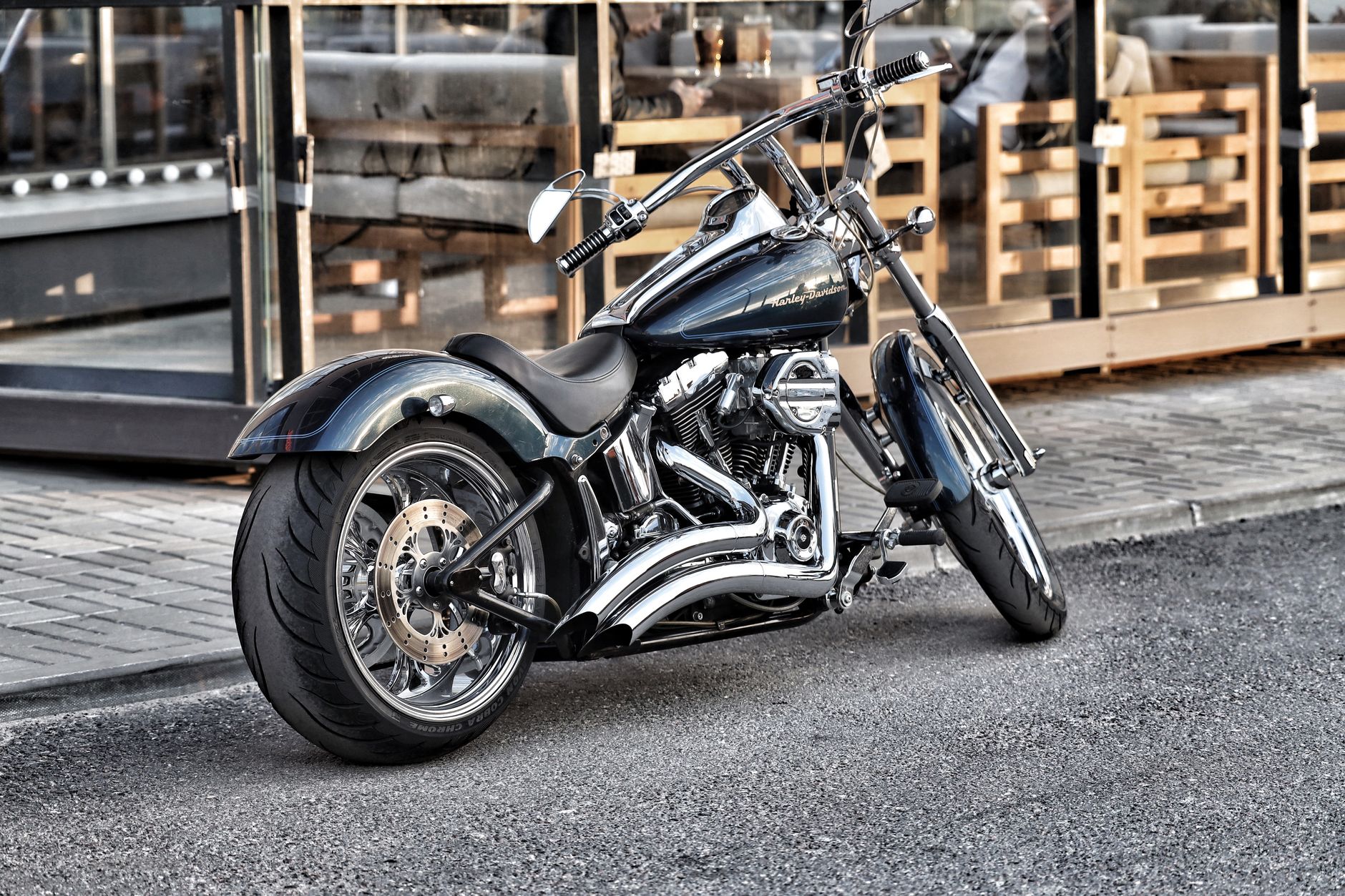
On February 1, 1994, Harley-Davidson filed U.S. Trademark Application 74/485,223, asking the federal government to grant it exclusive ownership of a sound — the lopey, uneven, mechanically distinctive idle of its 45-degree V-twin engine, the rumble riders had been describing as potato-potato-potato for half a century. The company spent the next six years in opposition proceedings, reportedly spent millions in legal fees, and then quietly withdrew the application in 2000 without ever securing the registration.
The story is one of the most expensive lessons in sensory branding ever filed in the public record.
What Harley was actually trying to own
The application described the mark in deliberately mechanical language: the exhaust sound of the applicant’s motorcycles, produced by V-twin, common crankpin motorcycle engines when the goods are in use. That phrasing matters. Harley was not trying to trademark a jingle or a logo chime. It was trying to register the mechanical byproduct of a specific engineering choice — two pistons sharing a single crankpin on a 45-degree V, firing at uneven intervals, producing a syncopated cadence rather than the smooth hum of an inline four.
The cadence is real. The 45-degree angle forces the cylinders to fire at 315 degrees and then 405 degrees of crankshaft rotation, leaving a long pause before the cycle repeats. That uneven gap is what the ear hears as potato-potato-potato. Honda, Yamaha, Suzuki, and Kawasaki all opposed the filing. Their argument was direct: any manufacturer building a 45-degree V-twin with a shared crankpin would produce the same sound, because physics, not branding, dictates the rhythm.
Why a sound trademark is so hard to defend
U.S. trademark law allows non-traditional marks — sounds, colors, scents, even textures — but requires the applicant to prove the mark has acquired secondary meaning. The public must hear the sound and think of one specific company, the way the NBC chimes mean NBC or the MGM lion’s roar means MGM. Harley had a strong case on consumer recognition. What it could not overcome was the functionality doctrine, which blocks trademark protection on any feature that is the natural consequence of how a product works.
The opposition essentially argued that the sound was not a brand signature added on top of the motorcycle. It was the motorcycle. And if rivals could build the same engine architecture and produce the same cadence, granting Harley exclusivity would hand the company a monopoly on an engineering category, not a marketing asset. Recent guidance on registering non-traditional trademarks notes that sound, color, and shape marks still face the highest evidentiary bar of any category, precisely because functionality challenges are so easy to mount.
The psychoacoustic problem nobody wanted to admit
The Japanese manufacturers brought engineers, recordings, and spectrograms. They demonstrated that a competing V-twin with the same firing interval produced a waveform indistinguishable from a Harley’s at idle. A trained rider could tell the difference under load, but the signature idle — the part Harley had built its filing around — was reproducible.
Sound discrimination is a measurable thing. Psychoacoustics research has long established that listeners identify engines by a small cluster of cues: fundamental frequency, harmonic spacing, and the temporal pattern between firing events. Match those three variables and the human ear cannot reliably tell two engines apart. Harley’s lawyers were not fighting Kawasaki’s marketing department. They were fighting the cochlea.
Why the brand spent six years anyway
From a pure-litigation standpoint, the case appeared increasingly difficult to win by 1995. From a marketing standpoint, every month of opposition was free advertising. Trade press covered each filing. Riders argued about it in dealerships. The phrase potato-potato-potato went from insider slang to mainstream shorthand for the brand. The application became a story about identity, heritage, and what a Harley is — which is exactly the territory emotional branding strategies identify as the most defensible competitive ground a heritage company can occupy.
When Harley walked away from the filing, it framed the move as a strategic decision rather than a defeat, and its lawyers continued to assert that the company held common-law rights in the sound even without a federal registration. Whether that framing was honest or face-saving, the underlying point held: Harley walked away from the legal fight owning the cultural association anyway. No competitor was going to advertise a Honda Shadow as the bike with the Harley sound. The customer had already made the connection the courts refused to certify.
The sensory branding lesson hiding inside the loss
The Harley case is now taught in marketing programs as a case study in why sensory ownership rarely needs a registration certificate. The same logic shows up in the way WD-40 protected its formula — by never filing a patent, the company avoided disclosing the recipe and kept the trade secret intact for seven decades. Harley took the opposite route and filed publicly, but ended up at a similar destination: the asset is defended by consumer perception, not paperwork.
The agency world has been catching up to this idea for years. Nathan Simpson, founder of the experiential agency FOAM, has emphasized how brands build deeper relationships through the alignment of sensory elements like sound, movement, texture, and narrative. The Harley idle is that alignment in its purest form — a sound that carries the brand’s entire mythology in three syllables of mechanical noise.
What other brands learned from watching
The case set a quiet precedent. Ducati never tried to trademark its dry-clutch rattle. BMW never filed on the flat-twin whir. Both companies watched Harley spend six years and millions on an application that ended in withdrawal, and concluded that the cheaper path was to make the sound a marketing asset without legal scaffolding underneath it.
Other industries took a different lesson. Harley’s failure helped clarify which sound marks could succeed: ones that are arbitrary rather than functional. The Intel chime works as a trademark because no laws of physics require a microprocessor to announce itself. The THX deep note works because no engineering principle dictates that audio systems must groan in B-flat. Harley’s sound failed the same test that color marks must pass, where ownership depends on the sensory choice being a deliberate identifier rather than an inherent property of the product. That distinction — between a sensory cue chosen as a brand signal and one baked into the product itself — runs through coverage of color psychology in marketing and branding.
The afterlife of the application
The withdrawal closed the file but not the conversation. Harley still uses the potato-potato-potato phrase in advertising, dealer materials, and merchandise. The 2017 Milwaukee-Eight engine was tuned, partly, to preserve the cadence under tightening emissions rules — an engineering investment that suggests the company still treats the sound as a balance-sheet asset even without federal protection. Recent shifts in trademark practice — including the evolving oppositions framework in Mexico and similar reforms across jurisdictions — have reshaped how non-traditional marks are challenged and defended, but the functionality bar remains the same wall Harley hit.
The deeper takeaway sits closer to the work covered in pieces like the Listerine halitosis campaign or the De Beers diamond engagement story: the most valuable brand assets are usually the ones the public has been trained to feel something about, not the ones a registrar has stamped. Harley spent six years discovering that the trademark office was the wrong venue for the fight. The right venue was every parking lot in America where a rider thumbs the starter and three syllables of uneven combustion announce what kind of motorcycle just arrived.
Walk past a Harley dealership on a Saturday morning and the sound is still doing the work the lawyers could not. No certificate required.
