
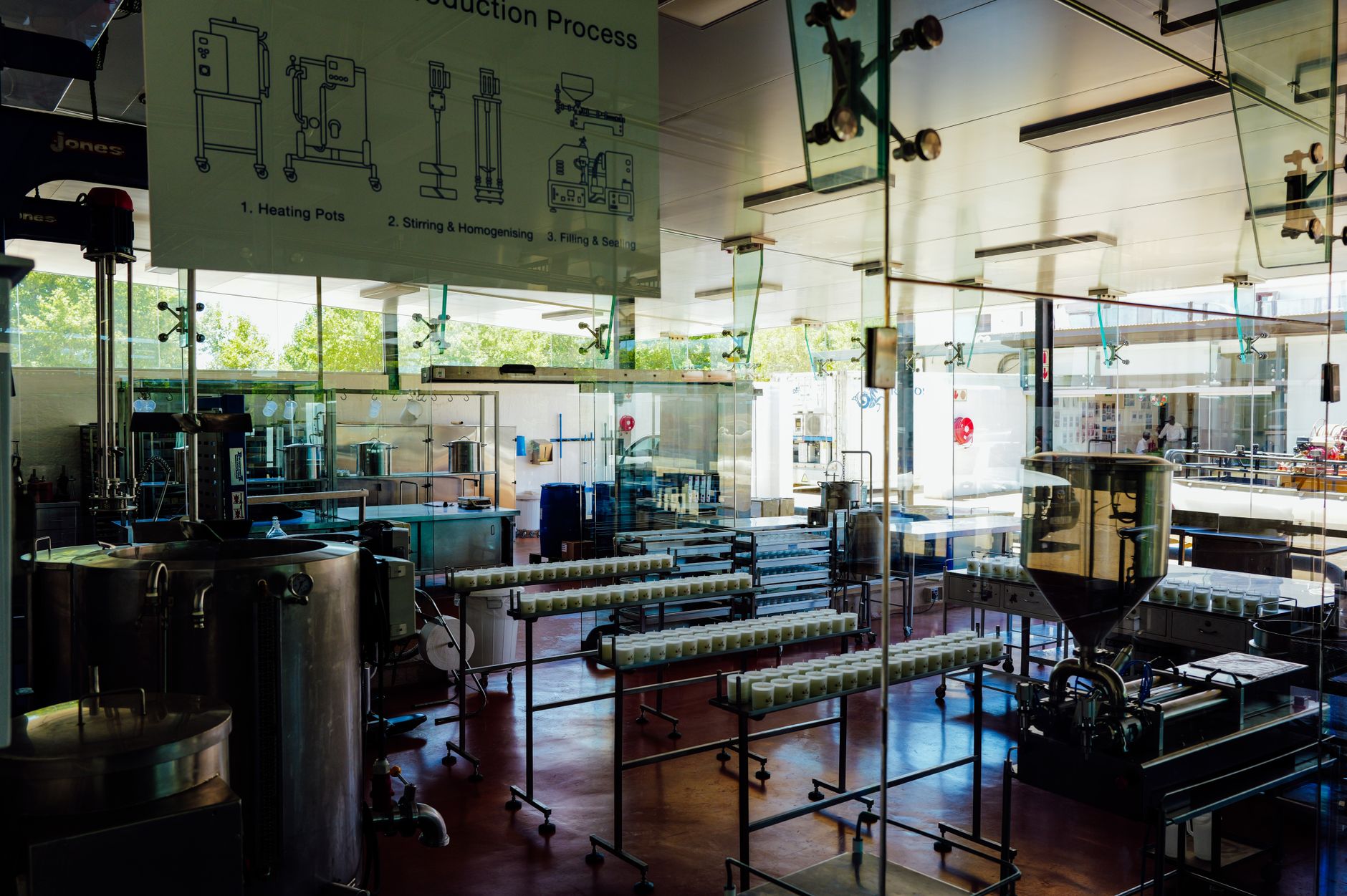
When a Gore plant in Delaware hit 201 employees, Bill Gore did something that would make most modern CFOs flinch — he split it in two. New parking lot. New building. New team. The man who left DuPont in 1958 to tinker with polytetrafluoroethylene in his basement built one of the most quietly successful private manufacturers in America on a single behavioral hunch: past a certain headcount, people stop feeling like they owe each other anything.
That number, in Gore’s plants, was 200. Close enough to what anthropologist Robin Dunbar would later popularize as the cognitive ceiling on stable human relationships — roughly 150 — that the company became the textbook case anyone teaching organizational design eventually reaches for. Gore-Tex fabric, dental floss, guitar strings, medical implants, fuel cell components. All of it made in deliberately small buildings, by deliberately small teams, on purpose.
The basement, the patent, and the rule
Wilbert L. Gore spent sixteen years as a chemical engineer at DuPont working on PTFE — the slippery polymer the world knows as Teflon. He believed it had applications DuPont was too big and too cautious to chase. So at 45, he and his wife Genevieve started W.L. Gore & Associates in the basement of their Newark, Delaware home on January 1, 1958. Their son Bob would later discover the expanded form of PTFE that became Gore-Tex.
The product story is the famous one. The management story is stranger and arguably more durable. Gore had read Elliott Jaques and watched DuPont’s hierarchy slow good ideas to a crawl, and he came out of that experience with a conviction that organizations rot from the inside the moment people stop knowing each other’s names.
So he capped his buildings. Around 150 to 200 people per facility, depending on which decade and which Gore historian is telling it. When a plant grew past the line, the company built another one — often right next door, sharing a parking lot but not a roster. The split wasn’t about real estate efficiency. It was about preserving the feeling that everyone in the building was personally accountable to everyone else.
Why 200 was the number
Dunbar’s number — the anthropologist Robin Dunbar’s estimate that humans can maintain roughly 150 stable social relationships — came out of primate neocortex research in the early 1990s, decades after Gore had already started cutting his buildings in half. Gore wasn’t quoting Dunbar. He was watching what happened on his own shop floors.
Past about 150 people, you stop knowing who’s new. Past 200, you stop knowing who left. The shift is subtle and behavioral. People begin to assume someone else will catch the mistake, raise the concern, stay late to finish the run. Psychologists call it diffusion of responsibility, and it shows up everywhere humans gather in groups too large to track each other. A recent essay in Psychology Today on the collective commons makes the same point in a civic register: when individuals stop feeling embedded in a visible group, their sense of personal stake in the group’s outcome erodes.
Gore’s intuition was that a factory is a collective commons too. If a welder in building seven doesn’t recognize the quality inspector in building four, the social pressure that makes work careful starts to evaporate. Splitting the plant didn’t just keep teams small. It kept the shame loop intact.
What replaces the org chart
Gore famously refused titles. Associates, not employees. Sponsors, not bosses. Leaders emerged because other people decided to follow them — a system the company calls its lattice. It sounds like Silicon Valley pamphleteering until you remember Gore was doing it in 1965, in a chemical plant in Delaware, with men in coveralls.
The lattice only works because the buildings are small. That is the part most flat-org evangelists miss. You cannot run a 30,000-person company without hierarchy and pretend the lattice scales. Gore didn’t try. He scaled by cell division. Each new building got its own plant leader, its own culture, its own informal social contract — and crucially, its own line of sight from the loading dock to the corner office.
Stoyan Mitov, a software CEO writing for Forbes, argues that flat structures speed decisions and lift engagement, but warns about role ambiguity and scalability problems as headcount grows. Gore’s answer to that warning was the wall. Literally. Build another building.
The scaling problem Gore solved by refusing to scale
Bob Sutton, the Stanford organizational psychologist who co-wrote Scaling Up Excellence with Huggy Rao, has spent decades studying what happens when companies try to spread something that works in one place to many places. In a conversation reissued by Harvard Business Review, Sutton describes the pattern he and Rao saw over and over: excellence doesn’t spread like a thin coat of peanut butter. It spreads in pockets. You get one location right, then the people who got it right go teach the next location, and the next.
That is almost a description of Gore’s playbook written forty years after the fact. Each new plant inherited associates from the old one. The culture rode in human bodies, not in handbooks. Sutton also points out that bigger organizations tend to pile on cognitive complexity — more process, more structure, more approval layers — and that the best scalers fight to keep things simple. Gore fought by keeping things small.
It is worth saying plainly that this approach has costs. Capital efficiency takes a hit. Duplicate facilities mean duplicate equipment, duplicate HR functions, duplicate everything. Gore was willing to pay for it because he believed the alternative was more expensive — measured in carelessness, attrition, and the slow death of mutual obligation.
What the 200-person rule actually protects
The rule isn’t really about productivity. It’s about felt responsibility — the same psychological mechanism that makes you lock the door when you live with two roommates and stop noticing whether it’s locked when you live in a 400-unit apartment building. Researchers studying group behavior during COVID found that strong ingroup belonging predicted whether people followed protective norms. The smaller and more visible the group, the more people behaved as if their actions mattered to others.
Gore’s plants ran on that exact dynamic. A defective Gore-Tex laminate doesn’t just fail a customer — it fails Linda, who runs the next inspection station, and Tom, who has to explain it on Monday. When Linda and Tom are abstractions, the laminate gets shipped. When they have faces, it doesn’t. This is the same observational thread Tweak Your Biz has explored before about how people manage the fear of being misunderstood in their personal communication — visibility changes behavior, and the threshold where visibility breaks is surprisingly low.
Why most companies can’t copy it
Plenty of executives have toured Gore facilities, nodded sagely, and gone home to run their 8,000-person divisions exactly as before. The rule is easy to admire and hard to implement, because it requires accepting that the org chart you have is too big for human psychology to handle, and that the fix is expensive real estate and duplicated overhead.
Newer research published in the Academy of Management Journal and summarized in Forbes suggests the most effective teams shift between flat and hierarchical modes depending on the task — which is, in a way, what Gore’s lattice does inside each small building. The hierarchy is situational and earned, not assigned.
Other founders writing about culture inside fast-growth companies keep arriving at versions of the same idea: as headcount grows, the founder’s voice gets quieter, and whatever rituals held the place together start to thin out. Gore’s answer was structural. Don’t ask culture to do work that geography can do.
Sixty-seven years later
W.L. Gore & Associates is still privately held, still run on the lattice, still building small facilities on purpose. The basement in Newark is long gone as a workplace. The rule isn’t. Walk into a Gore campus and you’ll find clusters of modest buildings, each with its own front door, each holding a group small enough that on a slow Wednesday afternoon the plant leader could plausibly know what every person in the building had for lunch.
That’s the part Bill Gore was protecting. Not efficiency. Not flatness. Not innovation, exactly. Just the small, embarrassing, deeply human fact that people work harder for people whose names they know.
- Why You Must Have a Recruitment Strategy
- The Secret To Productivity For Lawyers And Real People!
- Why Some Businesses Choose Outsourcing for HR and Payroll Management
- Effective Communication for Employee Engagement: Tips for Connecting with Your Team
- Modern Trends in Office Management
- Talent and Loyalty: How to Hire the Right People
