
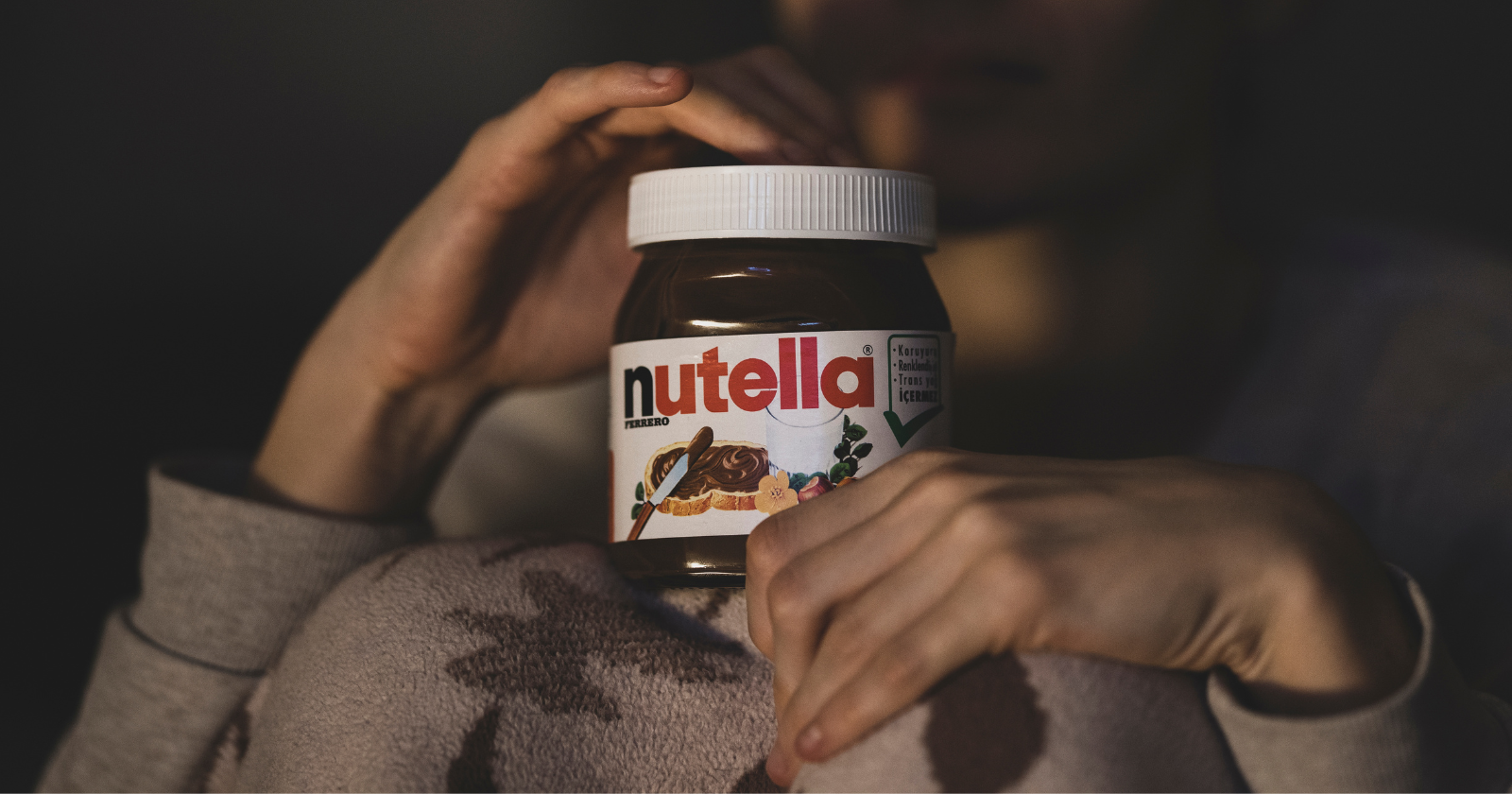
The most famous chocolate spread in the world started as a brick. In 1946, in the small Piedmontese town of Alba, a pastry maker named Pietro Ferrero mixed hazelnuts — abundant in the hills around Turin — with the tiny ration of cocoa available to postwar Italy and pressed the result into solid loaves wrapped in foil. He called it Giandujot, after Gianduja, the carnival mask of Piedmont. It sold by the slice, wrapped like soap, and mothers shaved it onto bread so their children could taste something close to chocolate without burning through a week’s sugar allotment.
Cocoa was the constraint. Hazelnuts were the workaround. The rest is a story about what happens when a product fails its environment and a company is brave enough to listen.
A loaf built around what was missing
To understand Giandujot you have to understand the math of 1946. Italy was rationed, broke, and rebuilding. Imported cocoa was a luxury item priced like jewelry. The Langhe hills around Alba, on the other hand, were full of tonda gentile hazelnuts — a nut so plentiful that Piedmontese confectioners had been stretching chocolate with it since the Napoleonic blockades of the early 1800s. Gianduja paste, the regional ancestor of Nutella, was already a century old.
Pietro Ferrero’s contribution was not the recipe. It was the format. By compressing the paste into a sliceable loaf, he turned a confectioner’s filling into a household staple — something a mother could buy once, store on a shelf, and portion across a week of breakfasts. A 100-gram brick cost a fraction of an equivalent chocolate bar. For families who had spent the war eating bread with olive oil or, when lucky, a smear of jam, it was a small restoration of normal life.
The slicing ritual mattered. Children watched a parent shave off a translucent sheet, lay it on a piece of bread, and hand it across the table. The product was inseparable from the gesture of being fed.
Why mothers were the real product designers
Ferrero did not invent the bread-and-Giandujot habit. Piedmontese mothers did. The company sold a loaf; households decided it was a spread-in-waiting. That distinction matters because it explains how the product eventually mutated.
Parental feeding choices are not incidental to how food categories form — they are the category. Research from Aston University led by Professor Jacqueline Blissett has shown that a parent’s own eating style strongly shapes how their children respond to food, including which textures and rituals get encoded as comfort. A generation of Italian children learned that chocolate arrived as a thin sheet on bread, handed over by a mother. That sensory memory became the brand before the brand existed.
Texture is doing a lot of work here too. Work catalogued by Nature on food texture preferences in early childhood finds that young children gravitate toward soft, non-particulate foods and that early exposure shapes lasting acceptance. Giandujot — firm at room temperature, melting at body temperature, smooth on the tongue — was almost engineered to be a child’s first chocolate experience, even though it had been engineered for cost.
The summer that broke the loaf
Then the climate intervened. Alba summers run hot, and the early Giandujot bricks, stacked on grocery shelves with no refrigeration, did not hold their shape. The loaves slumped. Foil wrappers leaked. Grocers complained. The unusually hot summer of 1949 made the problem impossible to ignore — and, as the company tells it, that slumped, spreadable consistency hinted at what the product might become rather than how it had failed.
Pietro did not live to act on it. He died in March 1949, worn out from personally driving his little Fiat through Piedmont to distribute the product. It fell to his son Michele — running the company alongside his mother, Piera, and his uncle Giovanni — to pull the recipe apart and rebuild it around the failure. They added more vegetable oil, softened the formula, and in 1951 reintroduced it as Supercrema, a spreadable paste sold in a glass jar. The summer melt was no longer a defect. It was the format. A jar could sit on any shelf in any season, and a child could spread the contents on bread without waiting for a parent to wield a knife.
Supercrema sold in volumes Giandujot never could. By 1964, Michele Ferrero had reformulated again — adjusting the fat profile, smoothing the texture, and renaming the product Nutella for international markets. The first jar left the Alba plant on April 20, 1964. Within a few years the spread had reached Germany and France, and by the late 1970s it was in Australia. Today the brand sells in more than 160 countries.
Reformulation as a survival instinct, not a marketing exercise
The Ferrero pivot reads as quaint until you notice that every major food company is doing some version of it right now. Hershey is reintroducing real chocolate to parts of its portfolio. Nestlé is restructuring around GLP-1-era consumers who eat less and want more from every bite. The trade press at FoodNavigator describes the current moment as a sector-wide reset rather than incremental tweaks, with sourcing, recipes, and formats all on the table simultaneously.
The triggers are different — appetite-suppressing drugs, tariff volatility, sugar regulations, climate-driven cocoa shortages — but the logic is identical to 1951. The product is failing its environment. The company either rebuilds it or watches it slump on the shelf.
Mouthfeel, in particular, has become the technical battleground. Recent industry analysis describes texture as one of the most underestimated variables in reformulation — for some consumers it matters even more than flavor. Ferrero understood this at the turn of the 1950s without the vocabulary for it. The slump of a melted loaf was a mouthfeel problem disguised as a logistics problem. Solving it required changing what the product felt like in the mouth, not just how it traveled.
What the Nutella story actually teaches operators
Three operational lessons survive the nearly eighty years between Giandujot and the current reformulation wave.
The first is that constraints are recipes. Cocoa rationing forced Ferrero toward hazelnut as a primary ingredient rather than a stretcher, which gave Nutella its distinctive flavor profile and its competitive moat — no rival could match the company’s hazelnut supply, because Ferrero spent decades locking up Turkish and Italian groves. Today Ferrero buys roughly a quarter of the world’s hazelnut harvest. The wartime scarcity became a permanent structural advantage.
The second is that distribution failure is product feedback. The melted loaves were not a packaging issue to be solved with refrigeration or thicker foil. They were the market telling Ferrero what the product wanted to become. Companies that treat physical failures as engineering problems usually miss the product insight buried inside them. The same pattern shows up in the Tupperware story, where unsold inventory on hardware shelves turned out to be a channel problem hiding inside a product that needed a completely different selling environment.
The third is that the user reshapes the category before the company does. Piedmontese mothers were spreading Giandujot before Ferrero sold a spread. The company’s job was to notice and follow. Consumer goods history is full of brands that watched customers misuse a product and rushed to correct them, rather than reformulating around the misuse. Some of the most durable repositionings — including Joe Coulombe’s rebuild of Trader Joe’s around an emerging consumer the rest of grocery had ignored — start with the same humility.
The slice that became a jar
Walk into an Italian kitchen on a weekday morning and a child is still being handed bread with chocolate on it. The form has changed — a butter knife now, not a paring knife; a jar with a screw lid, not a foil brick — but the gesture is intact. A parent makes the breakfast. The child eats something sweet. The brand inherits the ritual.
Pietro Ferrero died in March 1949, two years before Supercrema reached the shelves and fifteen before the first Nutella jar. He never saw either the spreadable paste or the jar that would help make his company one of the largest privately held confectioners in the world. What he built was a product flexible enough to survive the heat that broke it — and a household behavior strong enough to carry it across three generations and into more than 160 countries, one slice of bread at a time.
- Kickstart Your Culinary Dreams By Setting Up a Pick-Up Only Restaurant in Your Town
- Why Bother Upgrading Your Internet? Here Are 4 Clear Benefits for Your Home and Business Setup
- How to Start an Import/Export Business in 8 Easy Steps
- Pros And Cons Of Hiring a Business Coach
- 10 Web Design Techniques Could Be The Next Big Key To Conversion
- How to Create a Successful Online Jewelry Business
