
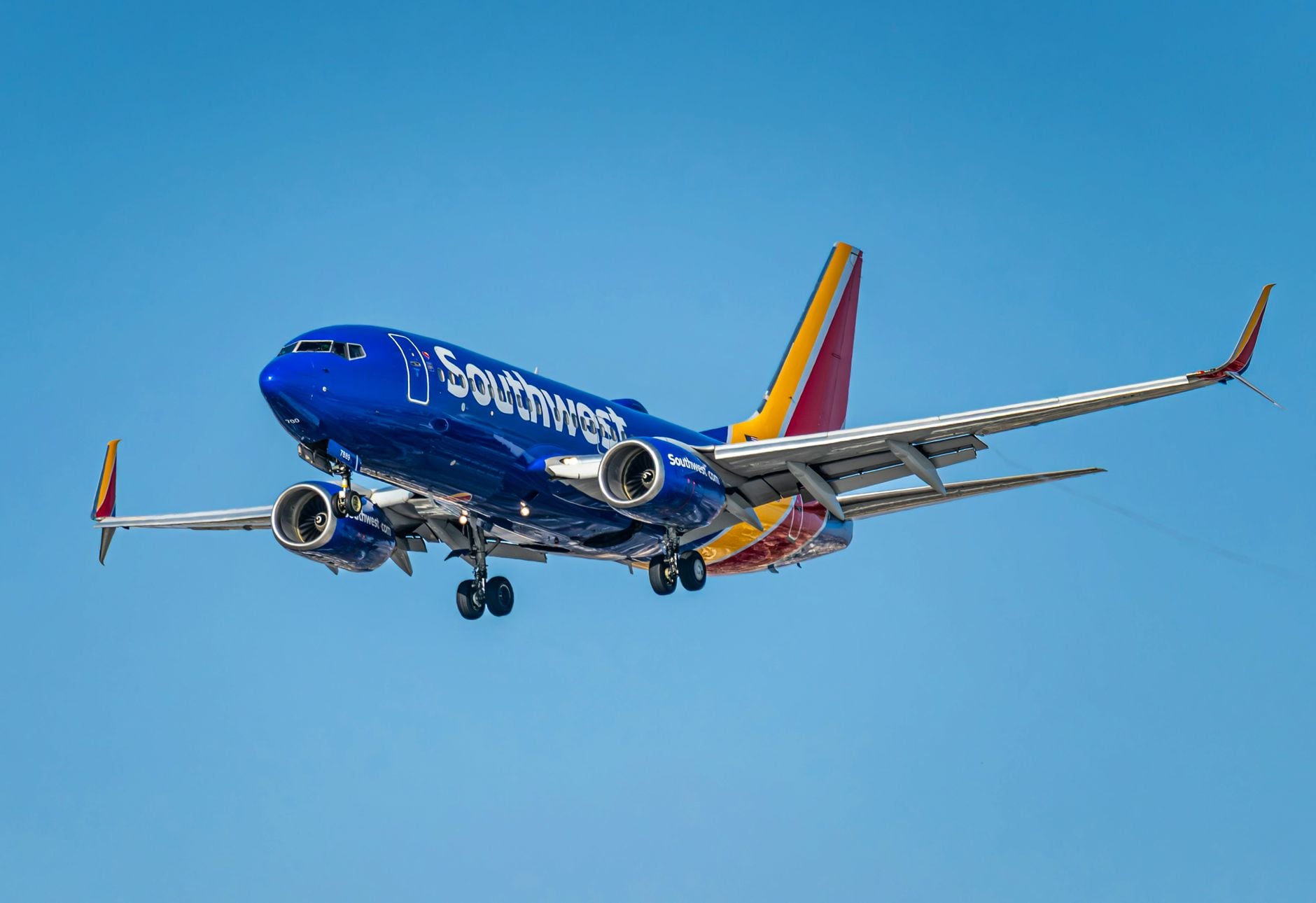
The cocktail napkin is the part of the story everyone remembers. The legal architecture underneath it is the part that actually built Southwest Airlines. When Rollin King grabbed a cocktail napkin in front of his San Antonio lawyer Herb Kelleher and sketched the three-city triangle, the lines connecting Dallas, Houston, and San Antonio weren’t drawn for romance or convenience — they were drawn because Texas was big enough to support a profitable airline that never crossed a state border, and an airline that never crossed a state border didn’t have to answer to the federal Civil Aeronautics Board.
That was the entire trick. The CAB, which regulated interstate air travel until deregulation, set fares for every airline that flew across state lines. It set them high. Carriers like Braniff and Texas International were locked into a federally approved price floor that made flying a luxury good. An intrastate carrier — one that stayed inside Texas — answered only to the Texas Aeronautics Commission, which had no such mandate.
Kelleher, the lawyer, saw the legal gap and walked King through it. Southwest could charge whatever the Texas market would bear, which turned out to be roughly half of what the federally regulated competition was charging on the same routes.
The loophole was the product
The geography came second. The regulation came first.
Texas had three things almost no other state had at once: two metro areas more than 200 miles apart (Dallas and Houston), a third major city to anchor the triangle (San Antonio), and enough business travel between them to fill planes multiple times a day. California had a similar setup — Pacific Southwest Airlines had been exploiting the same intrastate loophole there, and Kelleher and King studied PSA closely before drawing their napkin. The reason the triangle worked wasn’t that triangles are efficient. It was that the triangle fit entirely inside one state’s regulatory perimeter.
This is what economists call regulatory arbitrage — the practice of structuring a business to exploit differences between overlapping rule systems. The term usually shows up in finance, where banks book activity in whichever jurisdiction treats it most leniently. Southwest’s version was simpler and more visible: stay inside Texas, charge half price, win.
The competition understood the threat immediately. Braniff, Trans-Texas, and Continental sued to keep Southwest grounded, and the legal fight dragged on for nearly four years. Southwest didn’t fly its first route until 1971, with three planes serving Dallas–Houston and Dallas–San Antonio. The lawsuits weren’t really about safety or routes. They were about a competitor who had found a way to opt out of the price-fixing system everyone else depended on.
Why constraint produces the better idea
There’s a temptation to read this story as proof that Kelleher and King were maverick geniuses who saw what others missed. The more useful reading is the opposite: they were working inside a very tight box, and the box is what made the answer obvious.
Constraint often drives creative solutions. As discussed in psychological research on creativity, constraints provide the framework that makes innovative solutions possible — there needs to be a box before one can think outside it. Gutenberg needed the wine press before he could imagine the printing press. Kelleher and King needed the CAB’s pricing rules before the intrastate triangle made sense as a business.
The same principle shows up in self-imposed constraints as drivers of innovation. Founders who try to operate without limits tend to produce diffuse, expensive, mediocre products. Founders who pick a hard limit and design around it tend to produce something specific enough to be cheap. Southwest’s hard constraint was operating only within Texas, never crossing state lines. Everything else — the single aircraft type, the ten-minute turnaround, the open seating, the absence of meals — flowed from that one decision.
What 50% cheaper actually bought them
The price advantage wasn’t a marketing claim. It was a market-creating mechanism.
Southwest’s fares were significantly lower than the federally regulated competition. When Braniff tried to crush Southwest by slashing fares on Dallas–Houston, Kelleher’s team responded by offering passengers a free bottle of premium liquor with every full-fare ticket — and the campaign briefly made Southwest one of the state’s largest distributors of premium spirits. The promotion worked because Southwest already had a structural cost advantage Braniff couldn’t match without abandoning its interstate routes.
Kelleher framed Southwest’s mission as breaking up airline monopolies in Texas and giving Texans more affordable travel options, rather than simply building a better product. The framing is worth taking seriously. He didn’t say Southwest was building a better product. He said Southwest was breaking a cartel. The product followed the strategic intent.
By staying intrastate, Southwest also escaped union contracts that bound the legacy carriers, fuel-allocation rules during the 1973 oil shock, and the CAB’s labyrinth of route-approval processes that could take years. The legacy carriers were competing inside a regulated system designed to keep them all alive. Southwest was competing outside it.
The lesson most founders miss
Plenty of business writing treats the Southwest origin story as a parable about scrappy underdogs and bold vision. The actual lesson is more technical and more useful: the most defensible competitive positions are usually built on a structural asymmetry the incumbent cannot copy without destroying its own business model.
Braniff couldn’t match Southwest’s prices because Braniff’s network depended on interstate routes priced by the CAB. Matching Southwest on Dallas–Houston meant either losing money on that route or asking the CAB for permission to cut fares system-wide, which would have collapsed Braniff’s profitable long-haul business. The incumbent was trapped by its own scale.
This pattern repeats. The principle is that there are really only two ways to compete, and copying the leader on price is rarely one of them. Southwest didn’t copy Braniff cheaper. Southwest played a different game entirely.
The same logic shows up in Joe Coulombe’s reinvention of Trader Joe’s in the same era — a struggling convenience-store operator who survived by picking a customer the supermarkets weren’t serving and a product mix the supermarkets couldn’t replicate without cannibalizing themselves. Different industry, identical move.
What the napkin didn’t show
The Wright Amendment tried to put the genie back in the bottle. Sponsored by Fort Worth Congressman Jim Wright to protect the new Dallas-Fort Worth International Airport, it restricted Southwest’s flights out of Love Field to states bordering Texas — a federal attempt to claw back the very advantage the intrastate strategy had created. Southwest spent more than three decades fighting that restriction, which finally expired in 2014.
By then the airline had grown from three planes to one of the largest carriers in America. Southwest is now in the middle of its biggest strategic shift in fifty years, adding assigned seating and other changes that have driven its stock up sharply in 2026. The triangle is long gone. The cocktail napkin is in a frame.
What remains is the principle that drew the lines in the first place. Find the rule everyone else is paying to follow. Check whether you’re legally required to follow it. If you’re not, build your entire company in the gap. The competitors who could crush you are the ones who can’t follow you in without burning down their own house.
Kelleher kept a copy of that napkin on his office wall for decades. It’s a nice piece of folklore. The real artifact, though, was the Texas Aeronautics Commission’s jurisdictional boundary — the invisible line on the map that made every other line possible.
- 8 Ways to Boost Your Cold Pitching Effectiveness
- Before You Grow, What’s In Your Strategic Plan?
- 3 Tips for Staying Productive Outside the Office
- Where do you score on the passion stakes?
- The Top 4 Ways to Motivate Your Employees and Improve Productivity
- Magical Tricks that Experts Follow to Meet their Deadlines Every Time
