
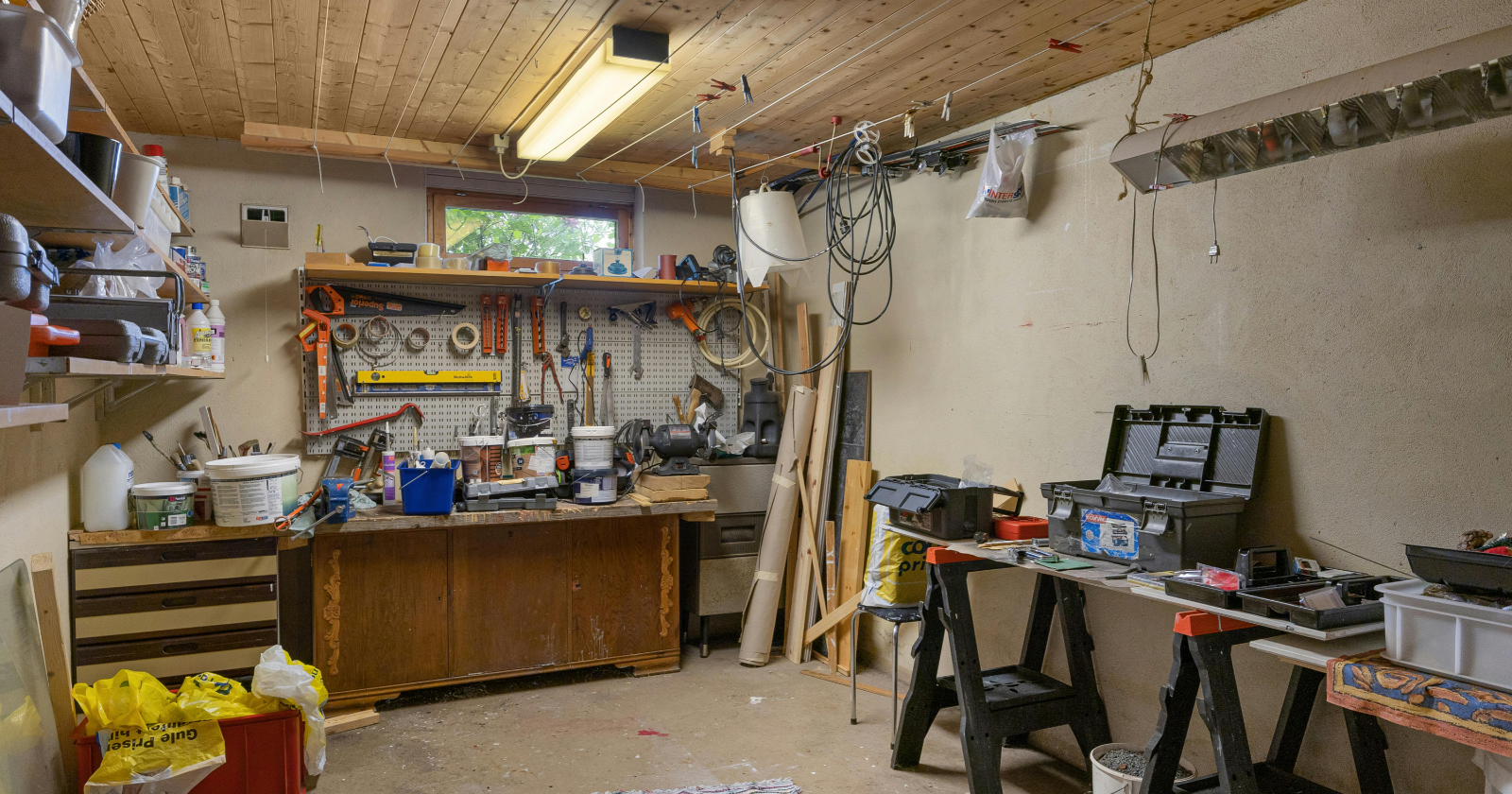
Growing up, I spent countless hours in my family’s garage helping my dad fix things.
Years later, when I helped a wealthy colleague move into his new house, I watched him walk through his pristine three-car garage with its epoxy floor and built-in cabinets.
“Why would anyone keep broken appliances?” he asked, genuinely puzzled after hearing about my childhood.
That moment crystallized something I’d always known but never articulated: The garage tells the story of how you grew up with money, or without it.
When you’re raised stretching every dollar, your garage becomes command central for making things last.
It’s not hoarding or laziness. It’s survival economics playing out in concrete and metal. Every item serves a purpose that people who’ve always had money simply can’t see.
1) The broken appliance waiting for parts
That old washing machine sitting in the corner? It’s not junk. It’s waiting for a $15 bearing from eBay instead of a $600 replacement.
Growing up, our garage housed at least two “dead” appliances at any given time. My dad would spend weekends watching YouTube repair videos, ordering parts, and bringing them back to life.
The upper class mindset says call the repair guy or buy new. The stretched-dollar mindset says that machine has eight good years left if you can fix the spin cycle.
You learn to see appliances as collections of parts, not disposable units. That dryer might donate its motor to fix the washer. The washer’s pump might fix the neighbor’s machine in exchange for help with your car.
This isn’t stubbornness. It’s understanding that a Saturday afternoon and a $20 part can save you a month’s grocery budget.
2) Three different types of oil and fluids
Walk into any lower middle class garage and you’ll find a shelf loaded with half-empty containers: Motor oil, transmission fluid, brake fluid, power steering fluid, coolant. All different weights and types. All partially used.
Why? Because when you change your own oil to save $40, you buy exactly what each car needs. The Honda takes 5W-30.
The old truck needs 10W-40. You keep the leftover quarts because you’ll need to top off eventually. You know that burning a quart between changes is cheaper than fixing the leak.
Meanwhile, people who’ve always had money just drive to the quick lube place. They’ve never laid under a car with oil dripping on their face, trying to remove a stubborn filter with a screwdriver hammered through it.
3) The collection of margarine containers and glass jars
Every garage shelf holds a selection of repurposed containers. Coffee cans full of screws. Peanut butter jars organizing washers. Margarine tubs storing everything from paint brushes to electrical tape.
This drives wealthy people crazy. “Just buy organizer bins,” they say. But those containers represent a mindset: Everything has a second life.
That mayo jar isn’t trash, it’s future storage. When you grow up careful with money, throwing away a perfectly good container feels wasteful.
Plus, these containers tell stories. That Copenhagen tin holding drill bits? Grandpa quit dipping twenty years ago but the tin soldiers on. The baby food jars with nuts and bolts? From when the kids were little and money was tighter.
4) Multiple project materials “for later”
Half a sheet of plywood. Extra fence pickets. Leftover shingles from the roof job. A partial bucket of drywall mud.
To someone who hires contractors, this looks like a mess. To someone stretching dollars, it’s an insurance policy.
That plywood will patch the shed floor. Those shingles will fix storm damage without calling insurance and raising premiums.
The fence pickets become garden stakes or shelf supports. You keep materials because you know you’ll need them, and buying new when you have perfectly good supplies sitting there violates every principle you were raised with.
The key difference: Wealthy people buy materials for specific projects. Working class people see materials as opportunities waiting to happen.
5) The working vehicle that looks dead
There’s always one vehicle that looks like it should be towed but starts every time. Rusted. Dented. Maybe missing a hubcap or sporting different colored panels.
But under that ugly exterior beats a reliable heart that gets 30 miles per gallon.
Upper class folks see an eyesore bringing down property values. Lower middle class folks see reliable transportation that’s paid off.
That truck hauls mulch without worry about scratching the bed. That old Civic gets you to work without a car payment eating your budget.
We keep these vehicles running through relationship maintenance as much as mechanical work. You know which mechanic gives honest prices.
Which junkyard has the part you need. Which YouTube channel actually knows what they’re talking about.
6) Tools from three different decades
The garage holds Dad’s Craftsman set from the 80s, Grandpa’s hand drill from the 60s, and Harbor Freight additions from last year.
Nothing matches. Half the screwdriver handles are cracked. The socket set is missing the 10mm (always the 10mm).
But every tool works. That old hand drill still bores perfect holes. Grandpa’s level is more accurate than the laser one at Home Depot. You don’t need matching tools when you understand that a wrench is just leverage and metal.
Rich people buy complete sets and upgrade when new models come out. Working folks inherit tools and add only what’s absolutely necessary. That mix tells the story of generations keeping things running.
7) The backup generator or space heater
Somewhere in that garage sits emergency equipment. A generator that’s been used twice in ten years. A kerosene heater from the ice storm of ’98. Window AC units for when the central air dies in July.
Wealthy people call the emergency repair service. Working people know that service might not come for days, and hotels aren’t in the budget.
So you prepare. You maintain backup systems. You remember what it felt like when the power was out for three days and you had no heat.
This equipment might look like paranoid hoarding to someone who’s never worried about the repair bill. But when you’ve lived through choosing between fixing the heat or buying Christmas presents, you understand backup plans.
8) The “good wood” pile
Every lower middle class garage has a stack of lumber that’s “too good to throw away.” Straight 2x4s from a demolition. Hardwood from an old desk. Plywood scraps larger than a dinner plate.
This wood has potential. It might become shelving, a workbench, a treehouse. You can’t just throw away good wood when lumber costs what it does.
My dad built half our furniture from salvaged materials, and it lasted longer than anything from the furniture store.
People with money buy wood for projects. People without money see projects in wood that already exists.
Bottom line
These eight items aren’t just garage clutter. They’re a masterclass in resource management that most wealthy people never need to learn.
Each broken appliance, fluid collection, and scrap pile represents thousands of micro-decisions about value, repair, and making do.
The real confusion isn’t about the items themselves. It’s about two different relationships with scarcity. When you’ve always had money, you solve problems with purchases.
When you’ve grown up stretching dollars, you solve problems with ingenuity, patience, and the accumulated knowledge of generations who did the same.
That garage isn’t messy. It’s equipped for a different kind of life, one where self-reliance isn’t a lifestyle choice but a financial necessity.
And honestly? The skills that garage represents, the mindset it builds, the community it creates when neighbors help each other fix things? That’s worth more than any pristine three-car garage with an epoxy floor.
