
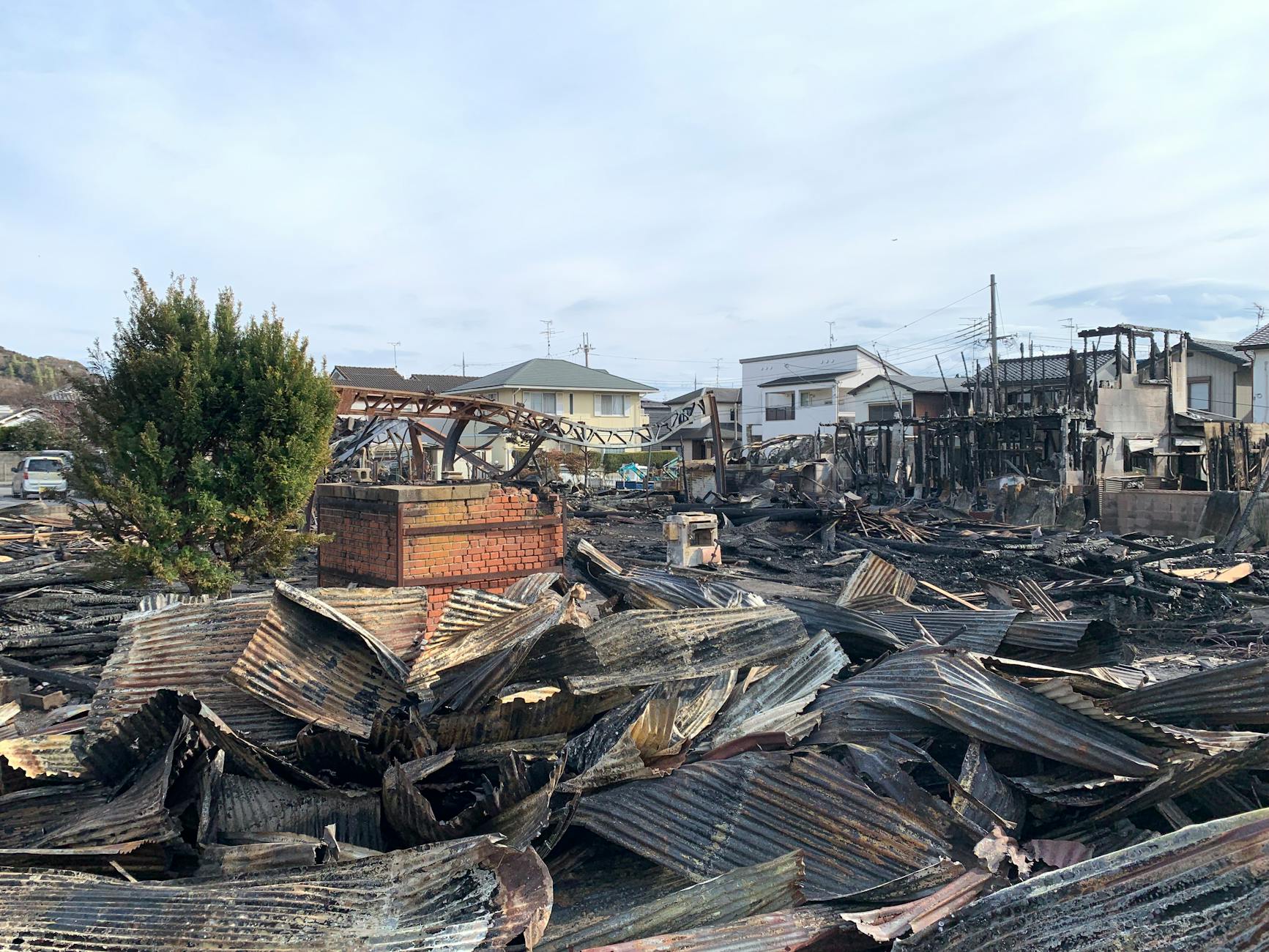
I’ll admit something. Whenever I hear about a tornado on the news, my first thought is always about the buildings. The roofs peeled back like tin cans, the cars flipped, the debris fields. I watch the aerial footage and my brain calculates lumber costs, insurance deductibles, rebuild timelines. I think most of us do this. We look at the physical wreckage because it’s visible, measurable, fixable. It took me years of watching people I know go through disasters to understand that the real damage doesn’t show up on a drone camera.
Last week, tornadoes tore through Southwest Michigan, killing four people and injuring at least twelve. The destruction in communities around Kalamazoo and Portage was severe. Right now, those survivors are in the phase that gets the most attention: the immediate aftermath. Neighbors are pulling together. Donations are arriving. The news trucks are parked on what used to be quiet residential streets. Everyone is focused on one thing: getting back to normal.
Here is what nobody will tell those survivors until it’s too late: normal isn’t coming back. A different version of it might. But the old version, the one where your house was just a house and a storm was just weather, that’s gone. And the gap between understanding that intellectually and feeling it in your chest is where the real recovery happens.
The Honeymoon That Ends Without Warning
Disaster researchers have a name for the first few weeks after an event like this. They call it the heroic phase, sometimes the honeymoon phase. People feel bonded by shared survival. There’s an almost manic energy to the cleanup. Strangers hand each other water bottles. Insurance adjusters become the most important people in town. There’s a clarity of purpose that normal life rarely provides: fix this, rebuild that, find somewhere to sleep tonight.
Then, slowly, the cameras leave. The GoFundMe donations plateau. The Red Cross moves on to the next event. And the survivors are left with something much harder than a demolished house. They’re left with their own nervous systems, which are still operating as if the tornado is about to touch down again.
Karen Delaney, 51, a middle school counselor in Joplin, Missouri, told me once that the hardest part of surviving the 2011 tornado wasn’t losing her home. It was the eighteen months that followed, when every spring thunderstorm made her hands shake and her mind go blank. Her house was rebuilt in seven months. She didn’t sleep through the night for nearly three years.
This pattern is so consistent that researchers now call it the “messy middle” of disaster recovery, the period after the adrenaline fades but before genuine psychological healing begins. It is the most dangerous phase, and the one that gets the least public attention.
The Body Keeps the Weather Report
Tom Ressler, 38, is a plumber in Moore, Oklahoma. Moore has been hit by significant tornadoes multiple times. After the 2013 storm destroyed his shop and damaged his house, Tom threw himself into rebuilding. He was back in business within four months. Friends told him he was resilient. His wife said he seemed fine.
Eighteen months later, Tom was sitting in his truck during a routine afternoon rain shower and couldn’t turn the key in the ignition. His hands wouldn’t stop trembling. He described it to me as his body finally filing the paperwork his mind had been ignoring.
This is the pattern. The body stores the threat long after the logical brain has declared the crisis over. Research on the psychological harms of disaster shows that post-traumatic stress symptoms frequently emerge weeks or months after the event, precisely when external support has dried up. The timing is cruel: the moment you most need help is the moment everyone assumes you’re fine because the drywall is up and the lawn is mowed.
I’ve written before about how people struggle when the external scaffolding of their identity gets removed. Retirement does it. Divorce does it. And a tornado that erases your physical environment does it with savage efficiency. The house wasn’t just a building. It was the backdrop against which your entire daily reality played out. The kitchen where you made coffee at 6:15. The bedroom where the light came through the east window at a particular angle. These small, unremarkable details were doing heavy psychological lifting, and you didn’t know it until they were gone.
The Social Pressure to Be Grateful
Here’s the part that makes recovery even harder. Survivors face enormous social pressure to perform gratitude. You survived. Your kids survived. You should be thankful. And they are thankful. But thankfulness and terror coexist more easily than people want to believe.
Marcia Webb, 44, a dental hygienist whose apartment complex in Tuscaloosa, Alabama was destroyed during the 2011 tornado outbreak, described the dynamic perfectly. “People kept saying, ‘At least you’re alive.’ And I’d think, yes, I know. But I also can’t close my eyes without hearing that sound. Those two things are both true at the same time. Telling me to be grateful doesn’t turn off the sound.”
This is what Tweak Your Biz has explored in examining how pressure situations reveal character: crisis strips away the performance. You can only smile and say “we’re blessed” so many times before the gap between what you’re saying and what you’re feeling becomes its own source of anguish.
The people around survivors often mean well. But well-meaning people who haven’t been through a disaster tend to operate on a visible-damage model. If the house looks fixed, the person must be fixed. If the person is back at work, the crisis must be over. This is the equivalent of removing a cast because the X-ray looks good and then wondering why the patient can’t run a marathon.
What Katrina Still Teaches Us
Twenty years after Hurricane Katrina, researchers are still studying the long-term psychological effects on survivors. The consistent finding is that physical rebuilding and psychological rebuilding operate on completely different timelines. Structures go up in months. Trust in your own safety can take years to reconstruct, and it is never the same structure it was before.
The Southwest Michigan tornado survivors are about one week into this process. The adrenaline is still high. The community solidarity is still strong. In three months, most of the national attention will have moved elsewhere. In six months, insurance disputes will be dragging on and the novelty of living in temporary housing will have calcified into grinding frustration. In a year, the people who rebuilt fastest will be the ones quietly scheduling therapy appointments, wondering why they feel worse now than they did in the immediate aftermath.
Rehabilitation professionals have been sounding this alarm for years: when disasters fall out of the public eye, survivors continue to suffer, and the absence of sustained mental health support turns a recoverable trauma into a chronic one.
What Actually Helps
I’ve sat across from enough people processing hard transitions to notice a pattern. The ones who recover best aren’t the ones who are toughest. They’re the ones who give themselves permission to acknowledge that the ground shifted under them and it will take time for their internal compass to recalibrate.
For the people in Southwest Michigan, a few things matter right now more than drywall and roof trusses.
First, name the timeline honestly. Physical rebuilding: months. Psychological rebuilding: years. Knowing this in advance doesn’t make it painless, but it removes the additional burden of thinking something is wrong with you because you’re not “over it” by Christmas.
Second, watch for the delayed reactions. The person who held everything together in the first week, the one who organized the neighborhood cleanup and coordinated with FEMA, is often the one who collapses in month four. Strength in the acute phase can mask a nervous system running on fumes. Major ongoing research into trauma recovery confirms that delayed-onset distress is common, predictable, and treatable, but only if people know to look for it.
Third, resist the performance of being fine. The compulsion to signal that everything is under control is powerful, especially in tight-knit communities where everyone is suffering and nobody wants to seem like they’re handling it worse than their neighbor. But competitive resilience isn’t resilience. It’s suppression with an audience.
Fourth, accept that your relationship with weather has changed. This sounds small. It is enormous. For the rest of your life, a dark sky on a spring afternoon will carry weight it didn’t carry before. That’s normal. It doesn’t mean you’re broken. It means your brain did its job and encoded a life-threatening event as something to watch for. The goal of recovery isn’t to erase that encoding. It’s to keep it from running your entire life.
The Quiet After the Storm
I keep old notebooks from years of observing people navigate crises. One of the recurring notes I’ve scribbled in the margins is this: “real issue: not the event. The after.” It comes up in workplace upheavals, in family ruptures, in the specific kind of slow-motion identity crisis that follows any moment when the world demonstrates that it can rearrange your life in ninety seconds.
The people in Southwest Michigan are going to rebuild their houses. The lumber will arrive. The contractors will show up. The insurance checks will eventually clear. And somewhere in the middle of all that visible, tangible progress, a 42-year-old father is going to stand in his brand-new living room and feel less safe than he did in the basement shelter during the storm itself. Not because the room is wrong. Because the certainty that his walls could protect his family is something he can no longer access.
That moment, the one nobody photographs, the one that doesn’t make the news cycle, is where the real rebuilding begins. And it deserves at least as much attention, funding, and patience as the drywall.
