
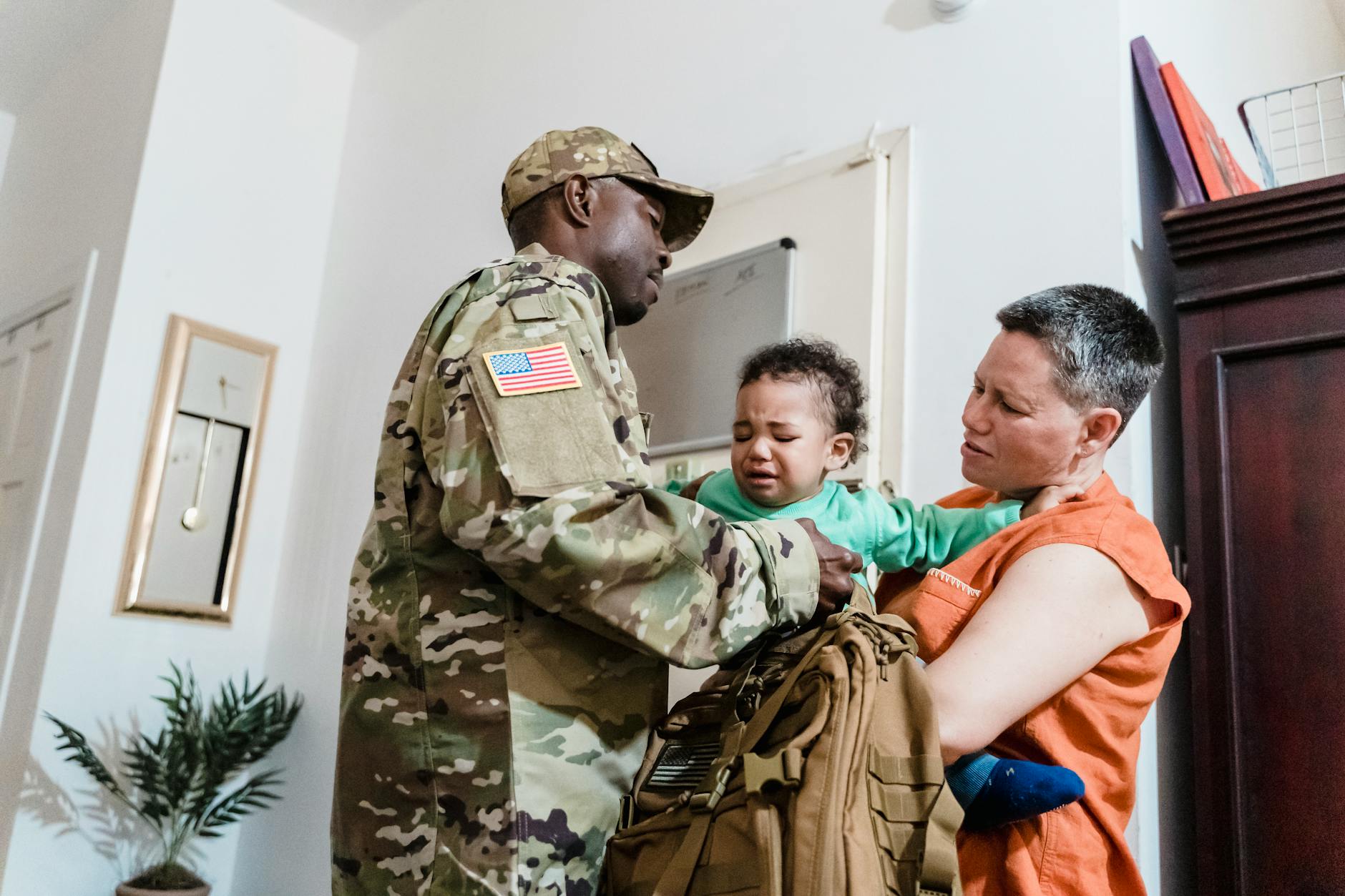
Megan Torres, 34, a dental hygienist in Killeen, Texas, was folding her daughter’s gymnastics leotard when the seventh name was confirmed. A soldier stationed in Saudi Arabia. Kentucky-based. She set the leotard on the dryer, opened her phone, read the headline, closed her phone, and finished folding. Her husband is deployed with the 1st Cavalry Division. She did not cry. She did not post anything. She texted her mother-in-law a yellow heart emoji and started making dinner. If you had walked into her kitchen at that moment, you would have thought she was fine. You would have been wrong.
The casualty count in the Iran conflict has reached seven U.S. military deaths as of this week. Seven. A number small enough that many Americans absorb it the way they absorb a weather update from a city they don’t live in. But in military communities, from Killeen to Fayetteville to Tacoma, seven is not a number. It is seven kitchen tables where someone is not coming home. And every family connected to an active deployment is watching the count the way you’d watch a roulette wheel when your entire savings is on the table.
The Performance of Composure
There is a specific behavior pattern that emerges in military families during active conflict, and it looks almost exactly like calm. Steady voice on the phone. Normal grocery runs. Kids picked up on time. Laundry done. Smiling at the neighbor who says, “I’m sure he’s fine.”
Civilians see this and call it strength. They say things like “military families are built different” or “she’s holding it together so well.” What they’re actually witnessing is a deeply rehearsed form of emotional management that military spouses learn early and practice constantly. It is not the absence of fear. It is fear organized into a schedule.
Derek Coleman, 41, an Army veteran now working as a logistics manager in Clarksville, Tennessee, described it to me plainly. His wife held this composure through two of his deployments. “She had a whole system. She’d check the news once in the morning, once at night. Never in between. She kept the house running like a machine. Everyone thought she was tough. She was terrified every single day for fourteen months straight.”
This is what I’d call functional dread: the state of operating at full capacity while your nervous system is quietly running worst-case simulations in the background. It mimics competence so precisely that people around you relax. They stop checking in. They assume you’re okay because you look okay.
Why Civilians Misread the Signal
The misreading happens because most people have a binary model of distress. You’re either falling apart or you’re fine. If someone is making lunches and showing up to work and not crying at the PTA meeting, they must be in the “fine” category.
But anyone who grew up in a home where emotional stability was a performance knows this binary is a lie. We’ve explored how people who grew up with conditional love develop specific behavioral patterns around managing how others perceive their emotional state. Military families develop something structurally similar, except the conditioning doesn’t come from childhood. It comes from institutional culture.
The military spouse community has unwritten rules. You don’t panic publicly. You don’t undermine morale. You hold the home front. These aren’t suggestions. They’re social expectations enforced through peer dynamics on base and in family readiness groups. A spouse who visibly struggles can feel like she’s failing not just herself but her partner’s unit.
So the composure isn’t natural resilience. It’s a learned behavior reinforced by social consequences.
Seven Deaths and the Math Nobody Talks About
As the U.S. death toll has risen and officials have warned of more casualties to come, something shifts in the psychology of waiting families. Seven is no longer abstract. Seven is proof that this is real, that the danger isn’t hypothetical, that the notification teams are active and knocking on doors somewhere in America right now.
Every military spouse I’ve spoken with this week describes the same involuntary calculation: What are the odds? How many are deployed in his area? What’s the threat level where she’s stationed? They know these questions are irrational in the way they frame them. They do the math anyway, the way you’d count exits on a plane even though you know the statistics say you’ll be fine.
Rachel Nguyen, 29, a preschool teacher in Tacoma whose partner is a Navy corpsman, told me she has started sleeping with her phone on the pillow beside her. “Not to check the news. To make sure I hear it if it rings. Because if something happened, they call. And I need to hear it ring.” She paused. “My coworker told me yesterday I seem really centered lately. I almost laughed.”
That moment, the almost-laugh, is the gap between what military families are performing and what they are feeling. Rachel is not centered. Rachel is in a state of sustained hypervigilance that she has learned to make look like poise.
The Loneliness of Being Misread
Here’s what makes this particularly isolating. When people praise your composure, they are, in effect, closing the door on your honesty. “You’re so strong” is a compliment that functions as a boundary. It says: I’ve categorized you. I don’t need to ask more.
I’ve written before about the particular loneliness of being the person who holds everything together while nobody thinks to ask how you’re doing. Military spouses during wartime are the most extreme version of this pattern. Their competence becomes a cage. The better they perform stability, the less support they receive.
And the broader civilian world, right now, is largely distracted. The war’s effects are rippling across the Middle East and global economy, and the political conversation around the conflict is loud and polarized. Somewhere between the oil prices and the op-eds, the specific human experience of waiting for your person to come home alive has gotten very quiet.
What Functional Dread Actually Costs
The cost of this sustained performance isn’t visible in the short term. That’s part of why it’s so easy to misread. In the short term, the military spouse operating in functional dread mode looks like the most capable person in any room. She’s organized. She’s calm. She remembers the dentist appointment and the oil change and the permission slip.
The cost shows up later. After the deployment ends. After the conflict resolves, if it resolves. It shows up as a body that can’t downshift. As insomnia that persists even when the phone is no longer a threat. As a flinch response to doorbells that lasts years. As a marriage that survived the war but can’t survive the return to normal, because “normal” requires a kind of vulnerability that the spouse trained herself out of.
Derek Coleman told me his wife didn’t sleep through the night for almost a year after he came home from Afghanistan. “She’d wake up and check her phone. I was right there next to her. Didn’t matter. Her body was still waiting for the call.”
This is the afterlife of functional dread. The performance ends, but the nervous system doesn’t get the memo.
The Civilian Responsibility Nobody Mentions
There’s a tendency, when talking about military families, to frame everything as tribute. We honor them. We thank them. We put yellow ribbons on things. None of that is wrong, exactly. But it can function as a substitute for actual attention.
Actual attention looks different. It looks like the neighbor who doesn’t say “I’m sure he’s fine” but instead says “I brought dinner, and I don’t need you to tell me anything, but I’m here if you want to.” It looks like the coworker who notices Rachel is sleeping with her phone and doesn’t call it “being centered” but instead says “That sounds really hard.”
There’s something Tweak Your Biz has explored about how the most revealing thing about character isn’t crisis behavior but what people do in the small moments when nothing is at stake. This applies here in reverse. The small moments of genuine attention toward a military family, the ones that cost you nothing but signal that you actually see them, those are the ones that matter. Not the public thank-you. The private noticing.
What Seven Means Right Now
Seven American service members have died in the ongoing conflict with Iran. For most Americans, that number registers as a news ticker update. For the families still waiting, seven is a proof of concept. Proof that the worst thing can happen. That it is happening. That the door they keep glancing at could open with the wrong kind of visitor.
And they will keep folding the laundry. They will keep packing the lunches and answering “How are you?” with “Good, thanks.” They will keep performing calm so convincingly that you’ll believe it.
The least we can do is stop believing it.
