
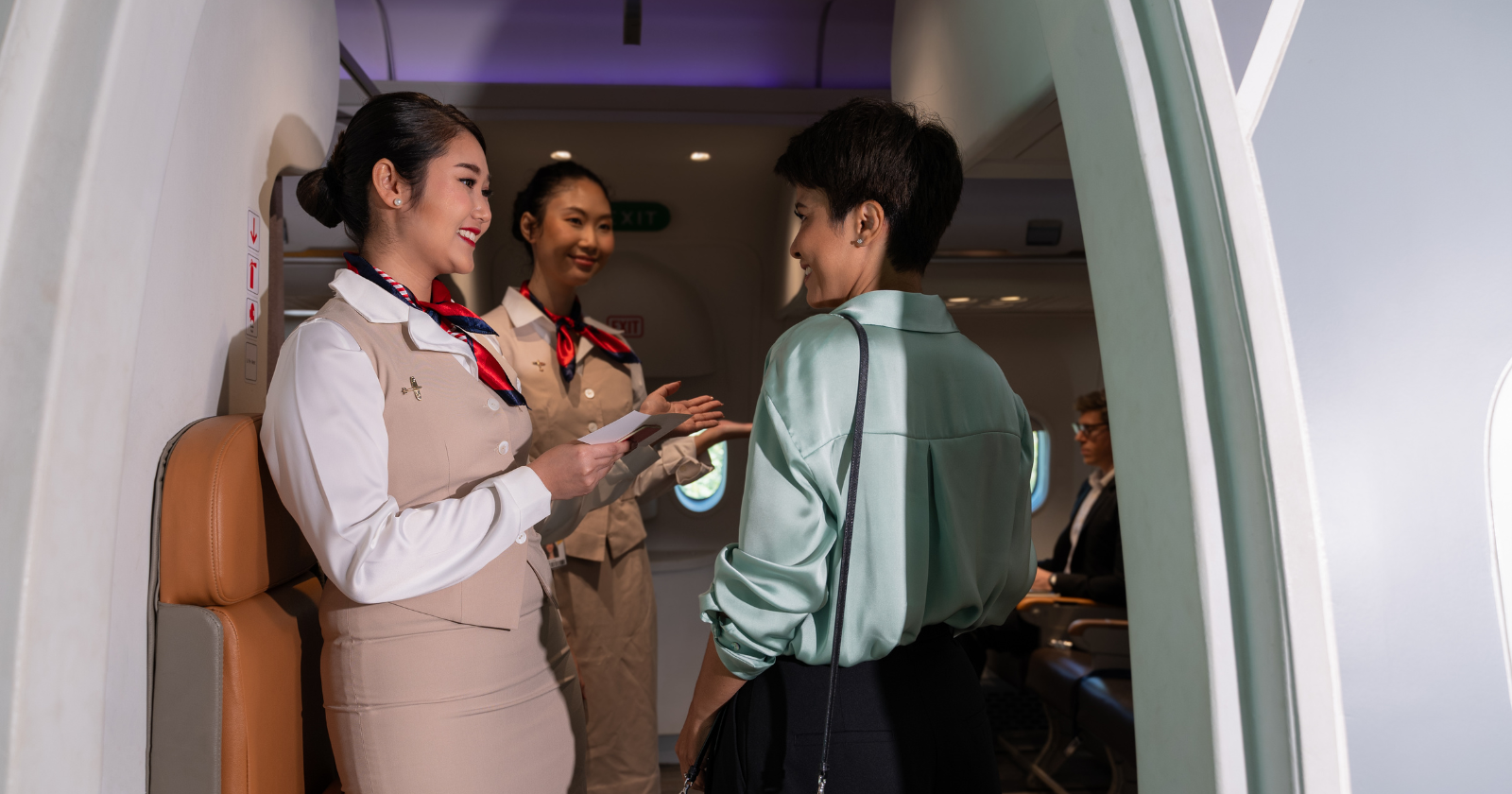
Last week, I watched a couple board a plane ahead of me. The woman was scrolling through her phone while her partner struggled with both their carry-ons, trying to lift them into the overhead bin.
A flight attendant immediately stepped in to help, but I caught the quick glance she exchanged with her colleague. That microsecond of silent communication said everything.
After years in brand and media work, where reading rooms was part of survival, I’ve gotten pretty good at noticing what professionals notice. But flight attendants? They’re operating on another level entirely.
They’re trained to assess hundreds of passengers in minutes, making split-second decisions about safety, service, and potential problems before takeoff. And most of us have no idea we’re being evaluated from the moment we step through that aircraft door.
Here’s what they’re trained to spot before you’ve even found your seat.
1. Your physical capability and willingness to help
Flight attendants are scanning for able-bodied passengers who could assist in an emergency. They’re not just looking at your physical build. They’re watching how you move, whether you help others with bags, and if you make eye contact when they greet you.
That greeting isn’t just customer service. It’s an assessment. Do you respond coherently? Are you sober? Do you seem alert and capable?
They’re mentally cataloging who sits in exit rows, who might help if needed, and who definitely won’t. The person who can’t lift their own carry-on probably isn’t getting mentally tagged as emergency assistance.
2. Your intoxication level
Think you’re hiding that airport bar session well? Think again.
Flight attendants are trained to spot signs of intoxication immediately. The slight sway while walking down the aisle. The overly loud greeting. The fumbling with the seatbelt. Even the smell that hand sanitizer doesn’t quite mask.
They’re not being judgmental. They’re calculating risk. An intoxicated passenger at 30,000 feet isn’t just annoying; they’re a potential safety hazard. They might not follow emergency instructions, could become aggressive, or might need medical attention mid-flight.
I once watched a flight attendant subtly position herself between a tipsy passenger and the cockpit door while appearing to simply organize the galley. Professional threat assessment disguised as routine work.
3. Your emotional state and potential for conflict
That couple having a tense whispered argument while boarding? Noted. The passenger who snapped at gate staff and is now settling into 14C? Flagged. The person whose jaw is clenched and hands are white-knuckling their armrest before the door even closes? On the radar.
Flight attendants are trained to spot emotional volatility because confined spaces amplify everything. They’re watching for signs of anxiety, aggression, or distress that could escalate once airborne.
They notice who’s patient when overhead bins are full and who immediately demands solutions. They see who helps the elderly passenger struggling with their seat and who sighs dramatically about the delay it causes.
These observations inform everything from their service approach to their emergency preparedness.
4. Who’s traveling together (even when you’re not sitting together)
Flight attendants quickly map out travel companions, even when seats are scattered. They watch for the subtle acknowledgments between people boarding separately. The shared look of frustration about middle seats. The person in 7A who keeps turning to check on someone in 22B.
This matters for several reasons. In emergencies, people will try to reach their travel companions regardless of instructions. Families with children spread across rows need different attention than solo business travelers.
And sometimes, people who claim they’re “not together” actually are, usually when they’re trying to work some angle about seating or baggage.
5. Your health status and medical needs
Without being obvious, flight attendants are conducting visual health assessments. Heavy breathing after walking down the jet bridge. Difficulty bending to store a bag. Medications being organized in seat pockets. The subtle wince when sitting down.
They’re not trying to invade privacy. They’re preparing for potential medical events. That passenger who seems short of breath might need oxygen later. Someone moving stiffly might not be able to assume the brace position.
They also notice medical devices, mobility aids, and service animals, making mental notes about who might need additional assistance or time during deplaning.
6. Your compliance likelihood
Within seconds, flight attendants can predict who will follow safety instructions and who won’t. It starts with the boarding process itself. Did you actually step aside when asked? Did you put your bag where directed, or did you argue about it?
The passenger who won’t put their phone down during the safety demonstration is the same one who won’t follow instructions during turbulence. The person who argues about storing their oversized bag is likely to argue about everything else too.
They’re particularly watching people in emergency exit rows. That quick confirmation that you’re willing and able to help? They’re assessing whether you actually mean it or just wanted the extra legroom.
7. Potential human trafficking situations
This one’s heavy, but it’s real. Flight attendants receive specific training on identifying potential trafficking victims. They watch for passengers who seem controlled by companions, who don’t have their own documentation, who appear fearful or disoriented.
They notice when someone won’t make eye contact, when a companion answers all questions for them, when there’s a significant age gap with strange dynamics, or when someone seems unaware of their final destination.
The training is sophisticated and specific, and flight attendants have prevented numerous trafficking situations through careful observation and appropriate intervention.
8. Your attitude toward service staff
How you treat flight attendants during boarding tells them everything about how the flight will go.
The passenger who makes eye contact and says thank you? They’ll get remembered. The one who treats them like furniture while demands pile up? Also remembered, but differently.
They notice who acknowledges their humanity versus who sees them as servants. Who understands the difference between service and servitude. Who recognizes that their primary job is safety, not comfort.
I once observed a flight attendant mentally categorize an entire first-class cabin within minutes based purely on how each passenger responded to her initial greeting. The ones who treated her dismissively got perfectly professional service. The ones who treated her like a human got the same service delivered with genuine warmth.
Final thoughts
Flight attendants aren’t judging your worth as a person. They’re doing rapid risk assessment and resource allocation while maintaining professional composure. They’re identifying who needs help, who can provide help, and who might create problems requiring help.
Every observation serves a purpose: safety, security, and service, in that order. The greeting, the smile, the casual conversation? It’s all intelligence gathering wrapped in hospitality.
The next time you board a plane, remember that flight attendants are highly trained professionals conducting complex assessments while making it look effortless. That initial interaction isn’t just pleasantry. It’s evaluation.
And here’s what’s interesting: once you know what they’re looking for, you can’t unsee it. You start noticing the subtle positioning, the strategic conversations, the way they communicate with glances and gestures.
Make their job easier. Respond to their greeting. Follow instructions the first time. Help if you can. Recognize that they’re safety professionals who happen to serve drinks, not the other way around.
Because at 30,000 feet, when something goes wrong, these observational skills aren’t just impressive. They’re lifesaving.
