
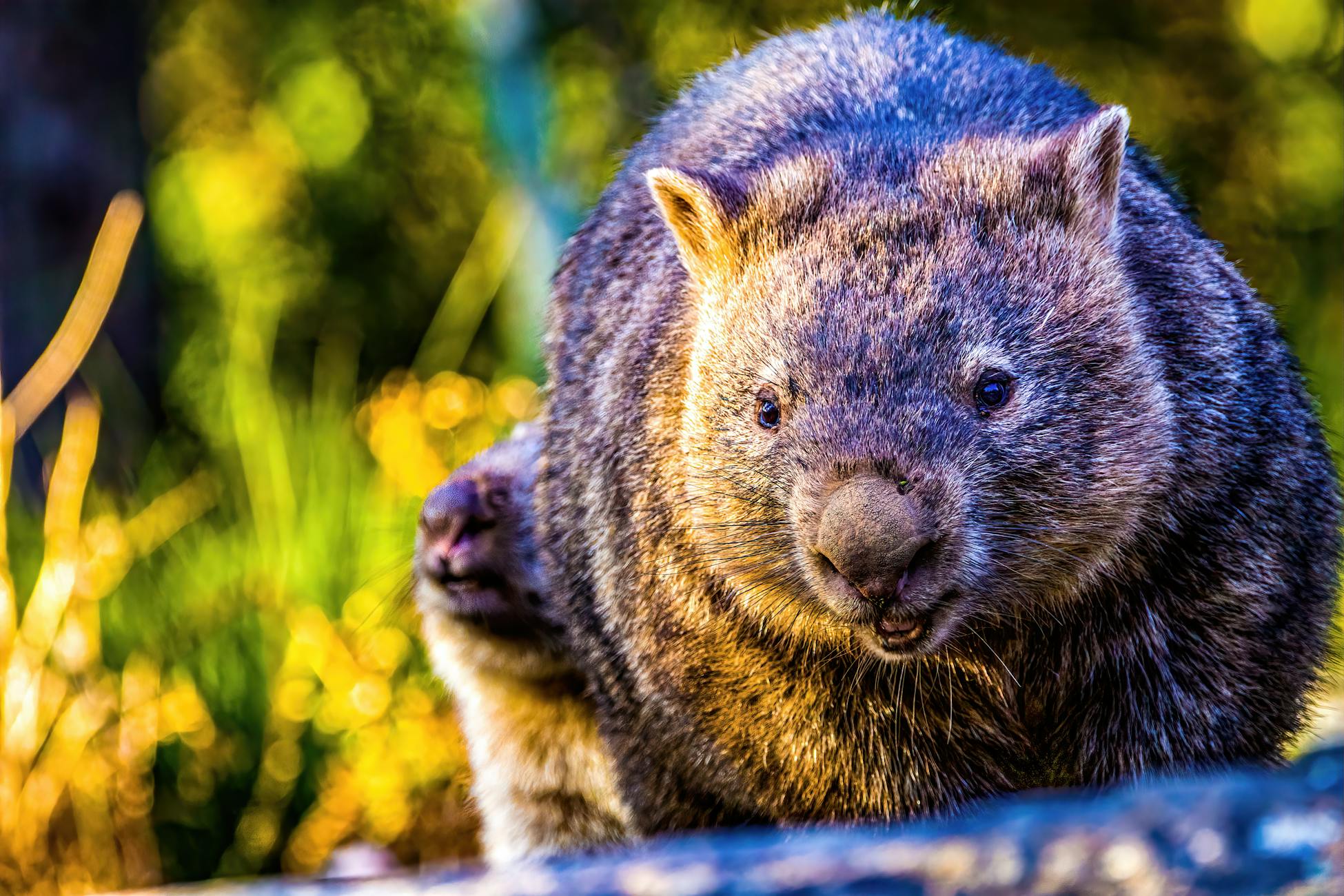
The bare-nosed wombat squats at the entrance of its burrow at dusk in the Tasmanian bush and deposits something no other animal on Earth produces: a small, dry, six-sided cube of feces, roughly two centimetres on a side, with edges sharp enough that it will sit stacked on a rock like a die without rolling off. A single wombat can leave up to 100 of these cubes a night, arranged on logs, mossy stumps and boulders as territorial markers. For decades, biologists had no idea how a soft, muscular tube of gut could possibly extrude geometry.
In 2018, a team led by Patricia Yang at Georgia Tech got hold of the intestines of two wombats that had been euthanised after vehicle strikes in Tasmania, and started cutting.
The animal that breaks a rule of biology
Almost every other creature on the planet produces feces that are some variation on a tube, a pellet, or a blob. The shape is dictated by the anus, which acts like a nozzle. Squeeze a soft material through a round hole and you get a round output. That is the rule.
Wombats break it. Their droppings come out as cubes, with flat faces and reasonably crisp edges, and they keep that shape long enough to dry in the open air. The cubes are not a curiosity of one individual or one population. Both species of common wombat do it, and the behaviour has been documented across the Australian mainland and Tasmania for as long as European naturalists have been watching them.
Why a marsupial would bother
Wombats are nocturnal, short-legged, and almost blind. They communicate largely through smell, and they use their droppings as billboards. A wombat that finds a good rock, a fallen log or a small rise will climb up and deposit cubes on top, where the scent travels furthest on the night air.
A cube does not roll. A round pellet placed on a log at 2am is gone by 2:01. A cube stays exactly where the wombat put it, with its flat face presented to passing neighbours. Researchers writing in IFLScience’s summary of the latest work on wombat latrines describe these stacks as functioning a little like dating profiles, communicating sex, reproductive status and territory to anyone who sniffs by.
Geometry, in other words, is a signalling advantage. If you cannot see well and you live alone in a burrow, your poop has to do the talking, and it has to stay put.
What Patricia Yang found inside the gut
Yang’s team, working with collaborators at the University of Tasmania, traced the digesta through the wombat’s intestines and noticed something strange in the last eight per cent of the gut. The contents went in as a soft, almost liquid slurry. Somewhere in that final stretch, they became firm, segmented, and increasingly angular. By the time they reached the end, they were cubes.
The team then did the simple, brutal experiment: they emptied a section of intestine, inflated it like a long balloon, and measured how much it stretched at every point around its circumference. A pig’s intestine, used as a control, stretched roughly uniformly. The wombat’s did not.
Around the wombat’s intestinal wall, the team found two stiffer bands running lengthwise, and two more flexible regions between them. As the gut contracted in waves to push material along, the stiff bands barely moved while the flexible regions squeezed inward. Over hundreds of contractions, repeated over the roughly two-week journey through a wombat’s unusually long digestive tract, the slurry was kneaded into a shape with flat faces and corners.
Two weeks in the gut
That two-week figure matters. Most mammals process a meal in a day or two. A wombat takes anywhere from 14 to 18 days, one of the slowest digestive transits of any mammal its size. The animal lives on tough native grasses and roots, and it squeezes every drop of water and nutrient out of them before the waste leaves the body.
That long, dry residency is part of what makes the cube possible. By the time the digesta reaches the final stretch, it has the consistency of stiff modelling clay, dry enough to hold an edge. As summaries of wombat biology note, almost all of the bare-nosed wombat’s evolutionary tuning has gone into water conservation in a dry continent. The cube is, in a sense, a side effect of a body built to waste nothing.
A goat fed similar material would produce round pellets. The wombat’s gut produces blocks because the walls themselves are uneven.
The physics, not the anus
The most counterintuitive part of Yang’s finding is where the shaping happens. It is not at the exit. The wombat’s anus is round, like everyone else’s. The cube is already formed well upstream and simply passes through.
This was a quiet shock to engineers. Most manufacturing assumes that to make a cube you need either a mould or a cutter. The wombat has neither. It has a flexible tube whose stiffness varies around its circumference, and slow, rhythmic contractions that act on the contents from many directions over many days. Out comes geometry.
The team published their findings at the American Physical Society’s fluid dynamics meeting in 2018. Engineers cited the work almost immediately as a possible new way to manufacture cubes from soft materials without cutting or stamping them, which is the kind of detail later coverage of wombat biology has continued to flag as an open industrial question.
An Ig Nobel and a serious idea
Yang’s team won an Ig Nobel Prize in Physics for the work, an award given for research that makes people laugh, then think. The laughter is obvious. The thinking is that a soft tube with patterned stiffness, contracting slowly, can produce shapes that engineers normally need rigid tools to make. Self-shaping soft materials are a serious problem in robotics, food production, and pharmaceutical manufacturing.
A wombat solved it about 25 million years ago.
Stacked on a log in the dark
None of this is what a wombat is thinking about at dusk in the Tasmanian forest. It hauls itself out of a burrow that may run ten metres underground, sniffs the air, and shuffles to its favoured latrine rock. It positions itself, deposits a cube, then another, then another, sometimes building small stacks that look almost deliberate.
By morning the cubes have dried hard in the wind. The scent has carried on the cold air to any other wombat within sniffing distance. The rock still has eight or nine little blocks sitting on it, none of them rolled away, each one carrying a chemical message about who owns this patch of grass.
Walk through wombat country in southern Australia today and you can still find them, lined up on logs like dice abandoned mid-game. Pick one up and it is dry, fibrous, and unmistakably six-sided. It is the only object of its kind produced by a vertebrate animal anywhere on Earth, and it was shaped, slowly, over two weeks, by a stretch of muscle no thicker than a garden hose.
- The art of not caring what others think: 10 simple ways to live a happy life
- 8 situations in life where a person’s true colors always come out, according to psychology
- People who go quiet in group conversations aren’t always shy — some are tracking too many social cues at once to find a clean entry point
- There’s a difference between being humble and being unable to take a compliment — one is about restraint, the other is about not believing the words
- People who reread the same text message five times before sending it aren’t being careful — they may be managing an old fear of being misunderstood
- 8 quiet signs someone has emotionally outgrown a friendship long before they’ve said anything about it
